
Our Approach to Buyer's Guides & Featuring Competitors in Content
AI tools now cite self-promotional buyer's guides while recommending competitors. What the data shows, and how we think about the tactic depending on where your brand stands.


There's a tactic that's been common in B2B content for the last few years: publish a "best [category] software" buyer's guide, rank yourself at the top, and have it rank in organic search and shape the answers ChatGPT, Claude, Gemini, and Google's AI Overviews provide when buyers ask for recommendations.
Done from a position of authority, a buyer's guide can win you two things at once: becoming the solution AI recommends, and getting AI to adopt your framing of the category and its entrants in its outputs. But that payoff depends more on your overall marketshare and web presence than on the quality of the buyer's guides you publish.
That's why this tactic has gotten riskier for some early stage companies: recent analysis suggests that when a less established brand puts itself at the top of its own guide, AI tools may cite the guide as a source but feature competitors without giving the brand that created the guide a mention in the output.
This doesn't mean publishing buyer's guides is a bad investment. Our stance is, and has always been, that well-researched, useful content that helps buyers understand a category and make an informed decision on potential vendors belongs in any B2B content strategy. What has changed is what types of brands benefit from them in the short term, and that depends on where your brand stands today.
What the data actually shows
SEO researcher Lily Ray analyzed 100 B2B "best [category] software" queries across three dates this spring. Of the queries that triggered AI Overviews, 69% cited a brand's own self-promotional listicle but left that brand out of the actual recommendations, pointing buyers to competitors instead. Across the dataset, those self-promotional listicles earned 323 citations. In 224 of them, the brand that published the page was not recommended.
One example Lily showed was the AI Overview for the query "best lms for selling courses":
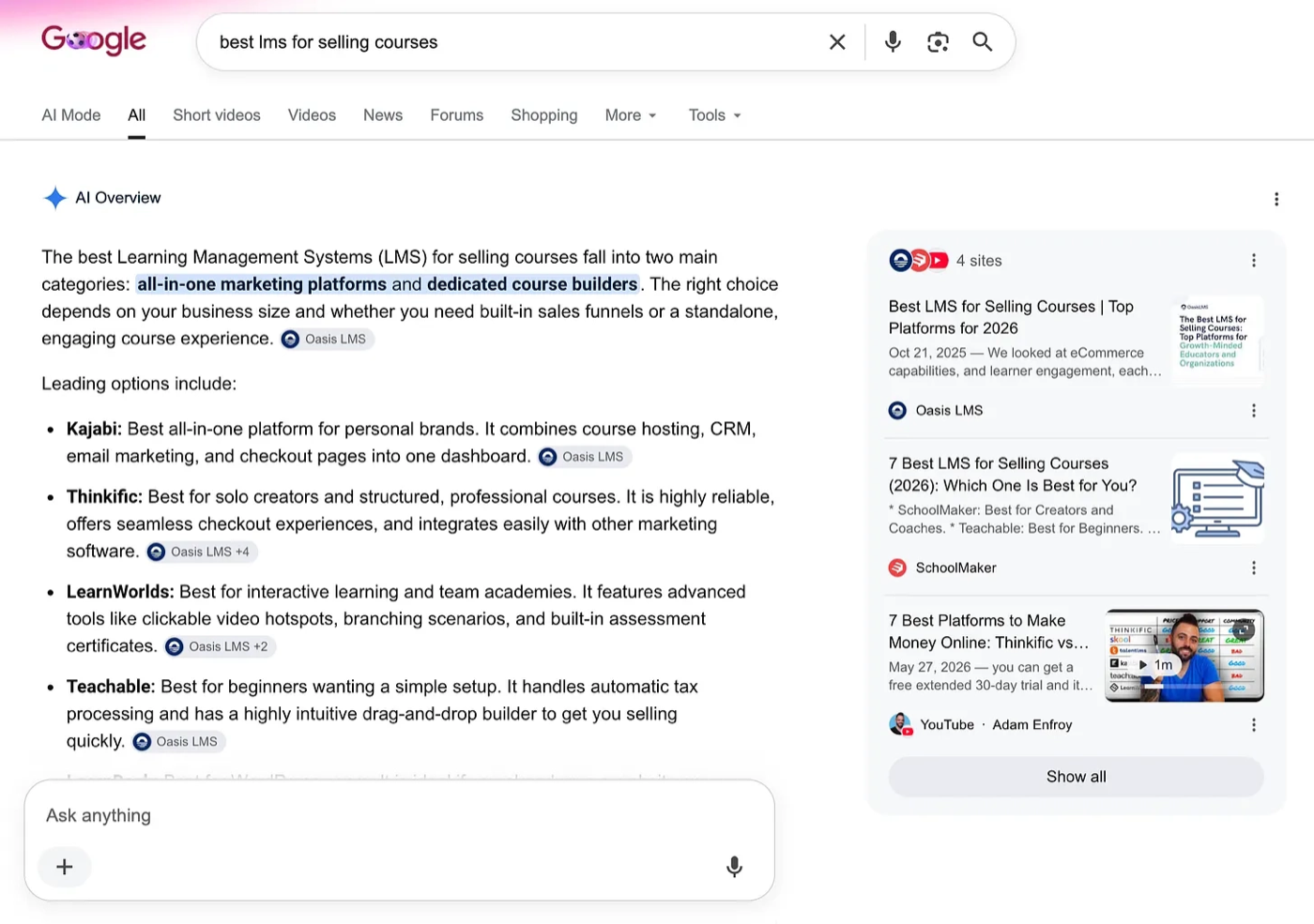
In this case, Oasis LMS's guide is cited throughout the AI response, but its brand isn't among the list of recommended vendors.
The Oasis LMS example captures the pattern seen across Lily's whole dataset: being cited and being recommended are two separate actions for an LLM. A citation (meaning an article was cited as a source in the AI response) just means a page was a useful article to pull information from. However a brand being recommended by an LLM in its output is determined independently from being cited, and a brand ranking itself at the top of its own guide doesn't necessarily help sway that determination.
For early stage companies with limited brand recognition and smaller online footprints, publishing a self-promotional buyer's guide can act as a "vote" for competitors to be featured in an AI response. The model pulls competitor names and comparisons from the early stage brand's page (and numerous other pages it pulls into its context window), and recommends their competitors, while leaving them out of the response.
Same format, opposite outcomes
A strong buyer's guide can earn citations from AI search, help shape how the category gets described in AI responses, and, if you are an established brand, put your product in front of buyers at the moment they're narrowing down a shortlist of vendors. But it's now clear that even the most comprehensive guides won't sway outputs unless they are published by brands with a strong market presence and online footprint.
For example, if you search "best AI data catalogs in 2026," Google's AI Overview returns a list led by Atlan, which gets top billing as "the best overall platform."
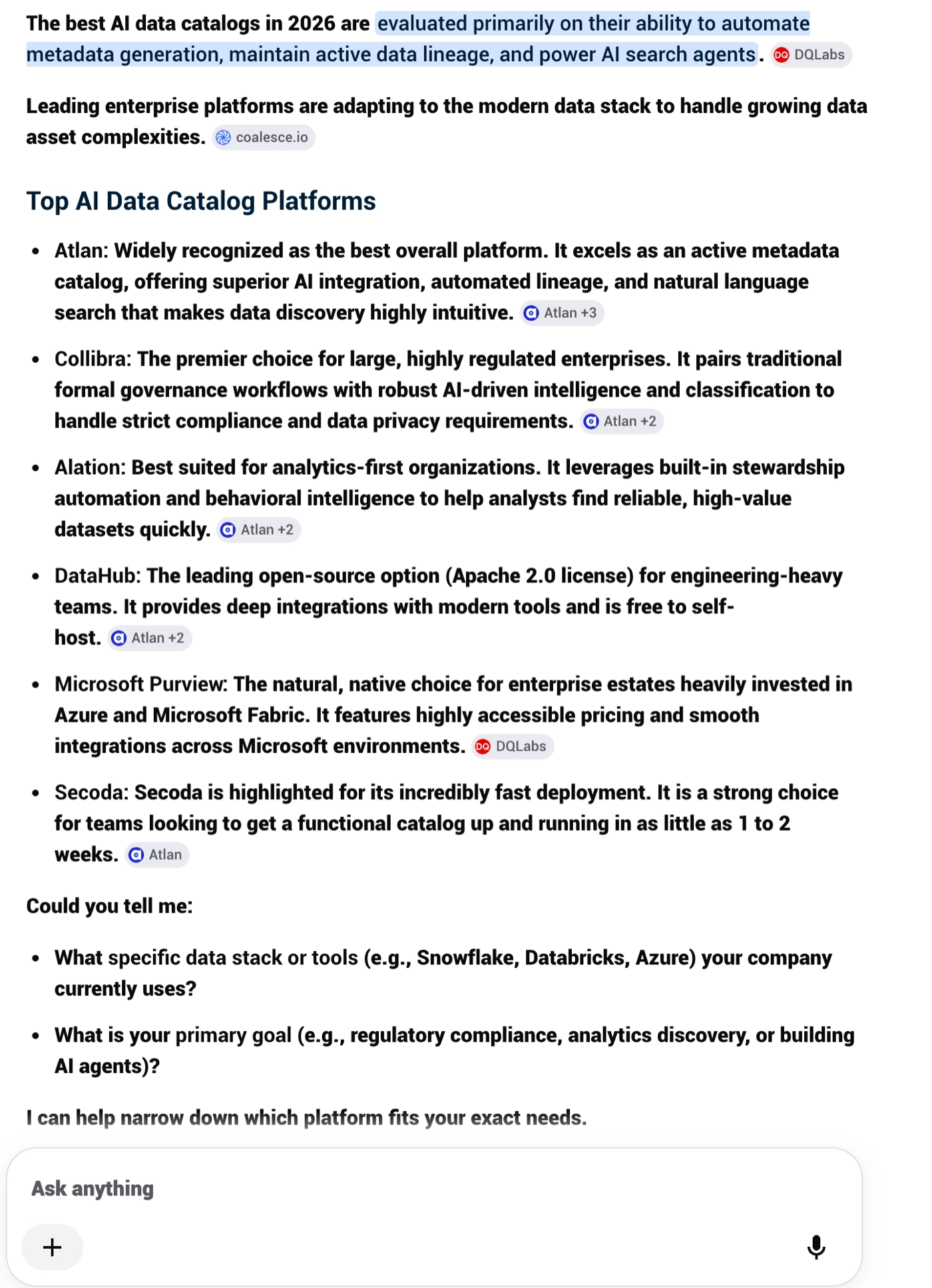
Notice the sources in the screenshot. The definition at the top of the overview is pulled from DQLabs, a smaller vendor that published its own "best data catalog tools" buyer's guide. But the names actually recommended are the category leaders, not DQLabs, even though they put themselves first in their own guide. That's the issue smaller brands face when executing this tactic: they may win the citation and even shape the output, but ultimately they could miss out on being recommended.
Atlan publishes the same kind of guide, a "best data catalog tools" list that ranks Atlan at the top. Atlan gets both cited and recommended here because it's a well-established brand on the Internet and a recognized leader that analysts like Gartner and Forrester hold in high regard. Around the web, any serious discussion of data catalogs as a category includes Atlan. Both Atlan and DQLabs published high-quality buyer's guides, but only Atlan was included in the output, and even without the buyer's guide, Atlan likely still would have been included in the output.
Atlan's success here goes further than just being the primary recommendation. Look at how the AI Overview defines a good data catalog in the first place: "automate metadata generation," "power AI search agents," and "active data lineage." The recommendation for Atlan is essentially carbon copy of that criteria. The takeaway here is that even when the definition of "best" is a set of table-stakes capabilities, the brand the wider web already trusts is the one that gets recommended against it.
If you're not a category leader yet, the lesson isn't "don't publish buyer's guides." It's that their upside is gated by your existing authority signals: third-party validation (e.g. G2, Gartner), online forum discussions, and brand visibility around the web. AEO discourse often stops at "are we in the answer?" instead of asking "are we credible enough to be recommended?" and that's something every brand now needs to consider.
If you already have the authority to back it up, publishing a definitive buyer's guide and shaping how the whole category, competitors included, get described is highly advantageous. If you don't yet have the authority to be included, you can still publish a guide on your category, but it's uncertain if it will influence AI outputs as intended.
From retrieval to recommendation
It helps to think of AI visibility as a ladder, not a binary "are you visible or not?" question:
- Retrieved. The model reads your content to help build its answer, but doesn't cite it.
- Cited. The model links your content as a source that shaped the answer.
- Mentioned. Your solution shows up in the answer as one option among several.
- Recommended. Your solution sits at the top of the shortlist the buyer actually considers.
Most prompt-tracking tools show you the first three rungs, and those are legitimate signals your content is doing its job. But retrievals, citations, mentions, and recommendations are governed by different selection criteria. Citation is about whether your content is useful enough to consult. Recommendation is largely a reflection of what the broader web (forums, video, review sites, press, analysts) says, whether you have a guide on a topic or not. If the consensus doesn't validate that your brand deserves to show up in the output, the AI may cite your guide and recommend someone else.
Not all mentions are positive
It's also possible that AI can mention you in a negative light and even recommend against you. In response to detailed, requirements-heavy prompts, some models have started doing the opposite of recommending brands. They are now naming specific products a buyer should avoid for their use case, and citing sources to support it.
For example, we prompted ChatGPT with the following: "What is the best stack (platform, CMS, frameworks) for launching a marketing website that utilizes streaming LLM responses with a database for RAG to give customers answers to their questions about our marketing offering when they land on our homepage?"
This was the response:
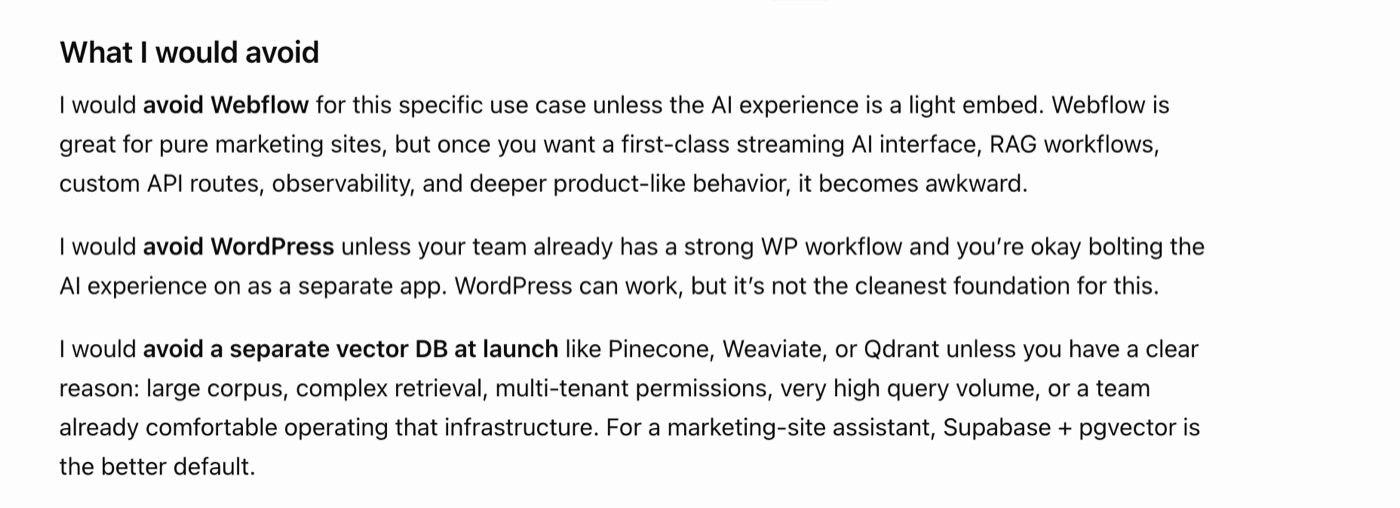
So the downside is no longer just being left off the shortlist. For a buyer with a specific set of needs, you can be explicitly named as the option to rule out.
Why recommendation is the ultimate goal
A single piece of content rarely sways an entire AI answer on its own; the output reflects the aggregate web. Two recent studies quantified what a recommendation is actually worth by watching real user behavior:
Scrunch built an opt-in panel that links a person's AI conversations to what they do next on the web, then compared each person's activity in the week after an AI answer against their own normal baseline. It separated a real recommendation ("a great option is X") from a passing mention.
The gap was roughly two to one: a recommendation moved people to search for, visit, and look at a brand about twice as often as a mention did. For buyers who had never encountered the brand before, a recommendation drove a 117% to 185% jump in branded searches, site visits, and product views within a week.
Being recommended is what actually sends a buyer looking for you.
SimilarWeb tracked thousands of real user journeys across multiple categories, following each person for seven days after they asked ChatGPT a question and got a specific brand in the answer to see whether they visited that brand's site or a competitor's.
When ChatGPT recommended a brand, that brand got roughly 2.5 times more new visitors in the following week than the competitors it left off the list. And very few of those visits look like AI traffic in a brand's web analytics. Only about 9% came directly from AI. The rest arrived through branded search and direct traffic, where they blend in with regular organic visitors.
AI recommendations already send real, engaged leads to sites, but most teams don't see that influence in their analytics, since it shows up as branded search and direct traffic that standard attribution tools don't reliably tie back to AI.
What this means for your GTM efforts
If you are an established category leader with deep third-party validation, nothing changes. Buyer's guides can have immediate pay off because the rest of the web already backs up what your content says and AI is likely to cite and be influenced by your content. If you are an emerging brand, a plethora of self-promotional listicles can be less impactful. Those guides may still earn visibility and clicks from traditional search, and being retrieved or cited isn't a wasted outcome, but you are less likely to be mentioned or recommended in the short term.
While a mention or recommendation may not be likely tomorrow, the upside for an emerging brand publishing buyer's guides is influencing how an LLM frames the market. If your description of your category and how you position against competitors gets pulled into the answer, that shapes how buyers will perceive your market, even if your brand isn't the one being mentioned or recommended.
Regardless of your overall market presence, truly valuable buyer's guides that help readers map the market and understand their options should have a place in your content strategy. But if you're still up and coming in your space, it's worth focusing on the most valuable buyer's guides for your ICP while also investing in getting your brand mentioned, reviewed, and discussed across the rest of the web so you're well represented online. Some of the most important channels to do that are:
- Review sites, where buyers and models both go to compare and contrast products.
- Forums and communities like Reddit, which AI answers lean on heavily.
- Earned media and PR, so independent sources echo your messaging beyond your own site.
- Inclusion in other sites' buyer's guides, not just your own.
- Original research and data that other sites reference.
- Analyst coverage in the categories where it carries weight.
The bigger picture is that earning an AI recommendation is harder to game than earning a top search ranking ever was, and that's mostly good news. The strategy doesn't change based on your size or stage: Be the best fit for a clear set of buyers, and give those buyers reasons to talk about you in public, where the models can retrieve it.
A note on attribution
Traditional attribution is breaking down. A buyer's path from first hearing about you to booking a demo now jumps across AI chats, search, social, communities, and direct visits, and no analytics platform sees the whole journey.
Say a buyer asks an LLM for the "best [category] software for [their use case]." They get a shortlist, then spend the next few days researching the names on it through Google and by visiting sites directly. When one of them books a demo, your analytics platform is unlikely to show AI assistants as the source.
That's why we don't judge this channel by last-click. We triangulate:
- AI-prompt tracking shows whether your brand is being recommended in LLM answers, even when those recommendations never produce a click your analytics can see
- Self-reported attribution ("how did you hear about us?") catches the buyers who heard about you through AI but landed on your site through branded search or direct traffic.
- Call recordings surface the language buyers actually use, which often reveals that an AI conversation shaped their shortlist long before they ever filled out a form.
No standalone signal is complete, but together they give a reliable read on whether you are being discovered, and increasingly, whether you are being recommended.
What we're doing about it
We're already tracking prompts across multiple LLMs for every client, which helps us (and you) understand when your content is being retrieved and cited and if your brand is being mentioned. But we've developed new custom tooling that goes further. We are running several pilot programs with select clients where we run all recorded AI responses that mention a client's brand through LLM-as-a-Judge evaluators that measure the language surrounding brand mentions that influences buyer behavior:
- If you're being recommended and not just mentioned
- If your positioning is being mirrored in AI responses
- If LLMs are telling users to avoid your offering
This kind of analysis isn't capable in any off the shelf AEO tool on the market today.
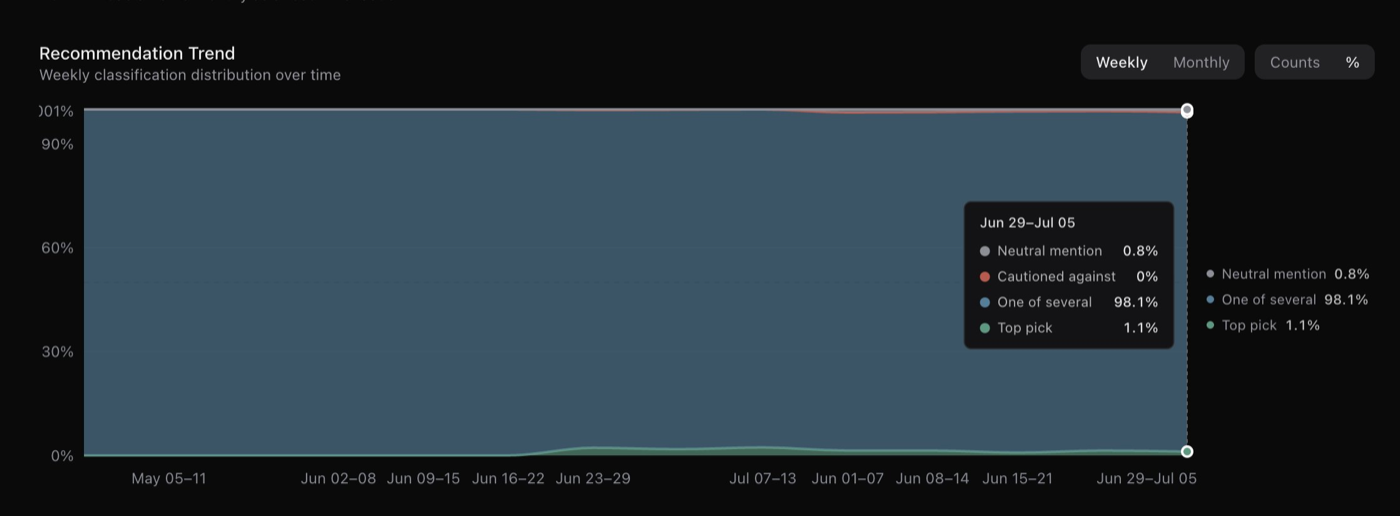
This additional layer of analysis enables us to find new opportunities for growth, whether that's improving existing on-site content, creating new content, or understanding the work beyond your own site needed to win a recommendation, like acquiring or updating offsite mentions.
As always, if you have any questions about this, please let us know and we can add it to the agenda for our next check-in.